
Jun 20, 2026
Why Manual PKM Systems Collapse — and What Replaces Them
Folders, tags, backlinks, dashboards. Almost everyone abandons the upkeep eventually. The failure isn't discipline — it's a system that asks you to be a librarian.
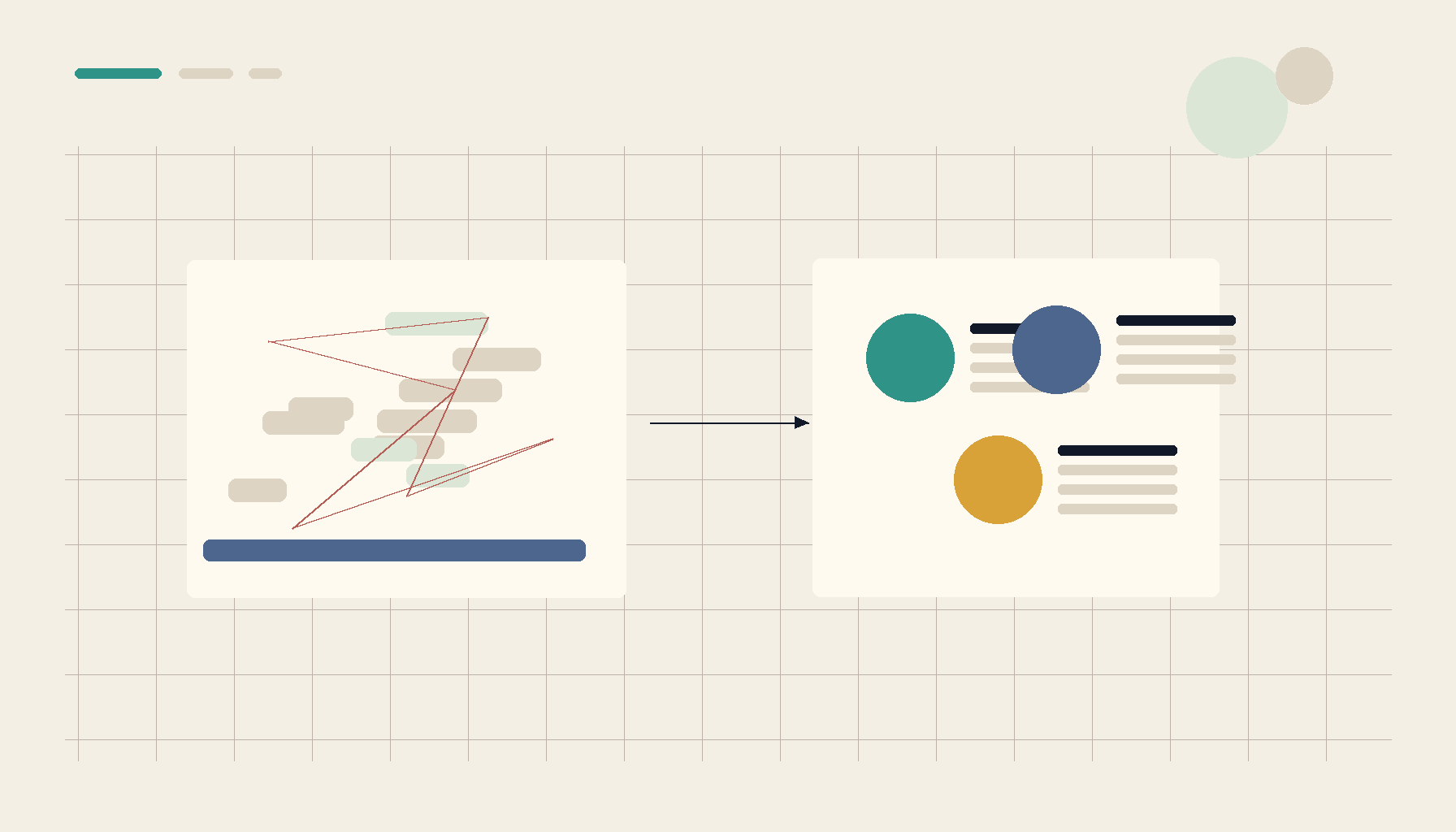
There's a confession thread that recurs in every knowledge-management community, almost word for word:
I genuinely wonder how many people actually keep up with folders, tags, backlinks, and dashboards long term.
The honest answer, judging by the replies, is: almost nobody. People build elaborate systems, run them beautifully for a few weeks, and then quietly stop. The structure freezes at whatever state it was in the day they gave up. New notes get dumped in unfiled. The dashboards go stale. Eventually they migrate to a new app and do the whole thing again.
And there's the sibling thread — "Notion, Obsidian, Jira... still not happy, what am I missing?" — where the assumption is always that the user is missing something. The right method. More discipline. A better template.
They're not missing anything. The model is the problem.
Manual PKM asks you to be a librarian
Every tag, every folder decision, every backlink is a small administrative task you perform in addition to the actual thinking. The pitch is that this upkeep pays for itself later in easy retrieval. And for a true power user with the temperament for it, sometimes it does.
For everyone else, the math never works. The cost is paid constantly, up front, on every single note — "where does this go, what do I tag it, what should I link it to" — while the payoff is occasional, deferred, and uncertain. You're doing librarian work every day to maybe save yourself a search someday.
People don't abandon their systems because they're lazy or undisciplined. They abandon them because they correctly sense they're spending more time maintaining the system than getting value from it. The upkeep is a tax, and eventually everyone stops paying a tax they don't see a return on.
Why "just be more consistent" doesn't fix it
The usual advice is to simplify — fewer tags, a flatter structure, a stricter daily ritual. It helps at the margins and then fails for the same reason, just slightly later. Any system whose organization depends on a human performing manual upkeep forever will decay the moment that human gets busy, distracted, or simply has a bad week. Life reliably provides all three.
The decay isn't a discipline failure. It's baked into any design that puts a person in the loop for routine, repetitive classification. You cannot out-discipline a structural cost. You can only remove it.
The model that actually survives: capture now, organize later
The version that holds up flips the order of operations. Make capture effortless and unstructured — get the thing in with zero decisions. Then let the system do the organizing afterward: read what you saved, classify it, tag it, and connect it to related material on its own.
This works because it puts the friction where it belongs. The expensive, judgment-heavy work — figuring out what something is about, what it relates to, where it fits — is exactly the work that doesn't have to happen at the speed of human attention, and exactly the work a machine can now do reasonably well. The human does the one part only a human can do: have the thought and save it. The system does the librarian part.
Crucially, you stop paying the organization tax on every note. You pay nothing at capture, and the structure emerges automatically rather than depending on you to hand-build and hand-maintain it.
What that looks like in 1AIVault
This is the principle 1AIVault is built on — capture should cost nothing, and organization should be the system's job, not yours:
- Capture without filing. Save a thought, a link, a snippet — no folder to choose, no tags to assign in the moment. The decision tax disappears.
- Automatic classification. What you save gets read and categorized for you, so structure accumulates in the background instead of waiting on your upkeep.
- Auto-tagging and linking. Related material gets connected automatically, building the web of associations that manual backlinking was supposed to create but never sustainably did.
- Organization that doesn't rot. Because nothing depends on you maintaining it by hand, the system stays coherent on your busy weeks — the exact weeks manual setups fall apart.
The reframe
If you've cycled through three note apps and a dozen folder schemes and still feel like you're failing at PKM, you're not. You were handed a model that quietly required you to become a part-time librarian, and you reasonably declined the job.
The fix isn't a better template or more willpower. It's a system that does the filing so you don't have to — one where the only thing asked of you is the thing you were good at all along: having the thought and getting it down. Let something else keep the shelves in order.