Jun 3, 2026
"Shared brain" across Claude, Cursor, and MCP — the language users already use
Founders describe the goal as a 'shared brain' that follows them across every AI tool. That's not just marketing — it's the language users have settled on for the continuity layer they want next.
Listen for the phrase. It started in scattered comments on Indie Hackers and the Cursor subreddit, then jumped into founder blog posts, and now turns up in conference talks. "My AI agent and I should share a brain." "I want one brain across Claude, Cursor, and ChatGPT." "I built a shared brain for my coding setup."
The wording is not technical. That's exactly what makes it useful. Users have landed on a phrase that captures what they want before any product taught it to them. "Shared brain" is the rare market term that compresses a whole product category into two words.
It's worth taking seriously, because it tells builders what to aim at — and how to talk about it.
What "shared brain" actually means in practice
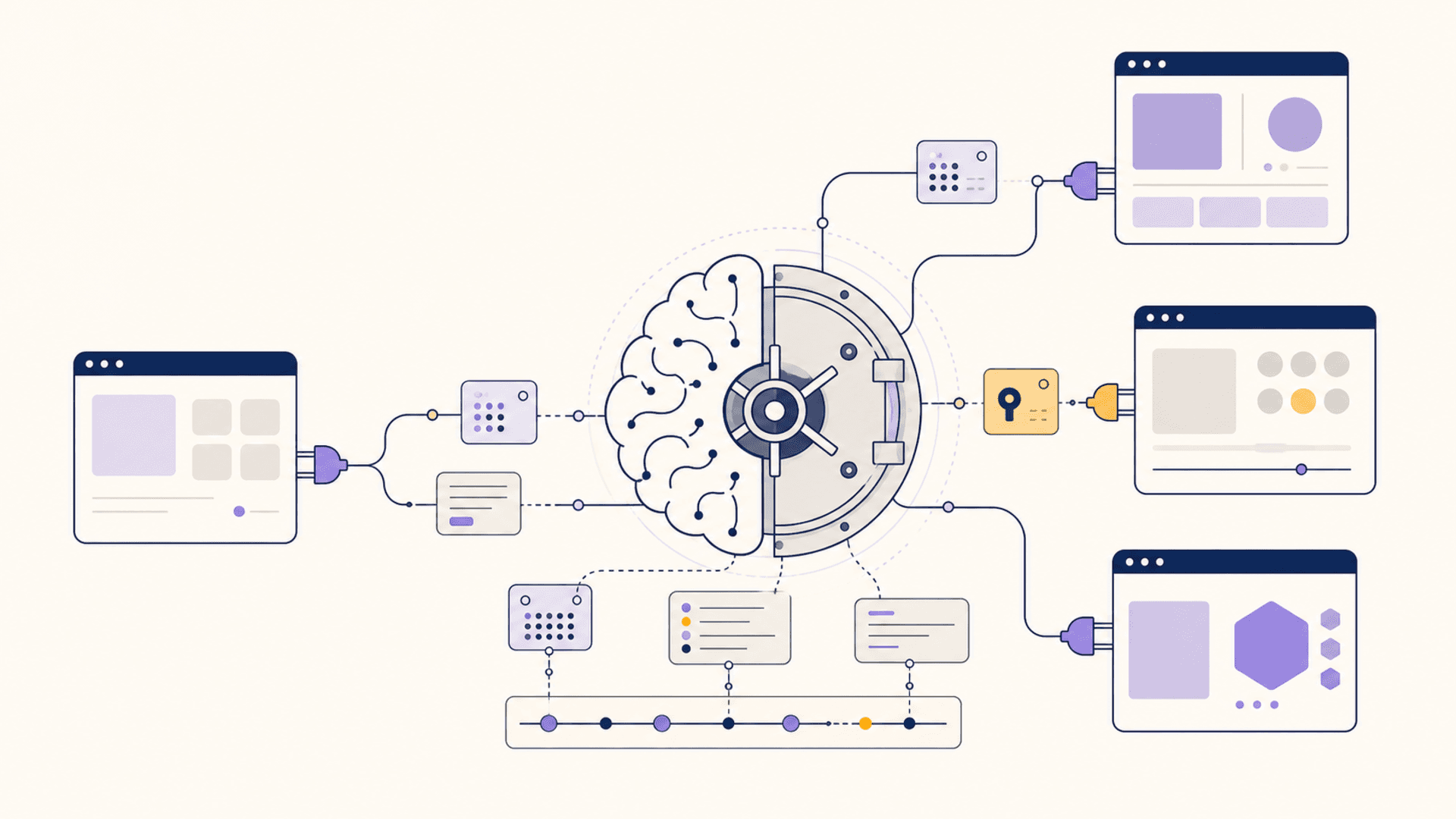
When a user says "shared brain," they don't mean they want their AI tools to think together. They mean something more practical: they want the substrate — the memories, the prompts, the context, the recent decisions — to be the same everywhere.
Concretely, the shared-brain wish list looks like:
- Memories that follow the user across Claude Desktop, Claude Code, Cursor, Cline, ChatGPT, custom MCP clients.
- Prompts that surface in every client without re-pasting.
- Project context the assistant can pull whether the user is on their laptop or phone.
- Recent decisions that one tool's session sees, another tool's session also sees.
- Style preferences and conventions that don't have to be re-explained every time.
Notice none of these need the model to be the same across tools. The model can be Claude in one client and GPT in another. The point is that whichever model is loaded today reads from the same substrate the user has been building.
The brain is shared. The mouths are different.
Why this framing is sticky
A few reasons "shared brain" outcompetes more technical phrasings.
It maps to the user's mental model. Most users don't think about retrieval pipelines or vector stores. They think about knowing things. "Does my AI know about X?" is the question that matters; "shared brain" is the answer that maps cleanly to it.
It implies persistence and growth. A brain that's shared with your agent is one that learns and remembers across the sessions you have together. The framing carries continuity without saying it.
It implies user ownership. Brains don't belong to vendors. The metaphor pushes toward the user as the owner — which is exactly the positioning local-first vaults benefit from.
It's tool-agnostic. Nothing in the phrase commits to a single client. The brain is portable; the mouths are interchangeable. Multi-tool reality is built into the framing.
A framing that does all four things at once is rare. Most product categories have to choose one. Builders should pay attention when users hand them this much for free.
What it tells builders to ship
If the market language is "shared brain," the product surface that earns the phrase has a few traits.
Cross-client retrieval is the default, not the upgrade. A brain that works only inside one tool is not shared. Multi-client retrieval has to be on day one, not behind an enterprise tier.
The brain is auditable. A brain you can't inspect is unsettling. The substrate has to let the user see what's stored, what got retrieved on a given turn, and what's about to be retrieved.
Updates feel like learning. When the user adds a memory or a prompt, the new entry is immediately available across all clients. Sync that has noticeable latency makes the brain feel slow, which breaks the metaphor.
Deletion is honest. When the user removes something, it stops being retrievable. The promise that the brain is theirs requires that they can choose to forget.
Scopes are first-class. A real brain knows context. The shared brain has to know when to surface work memories vs personal memories, when to surface team context vs solo context. Without scopes, the brain leaks across roles and the user backs off using it.
A product that ships these traits earns the "shared brain" phrase. A product that ships in-client memory tied to one vendor does not — and shouldn't try to.
What it tells marketers to say
The phrase is also free distribution. A landing page that uses the user's own language — "one shared brain across every AI tool you use" — converts faster than a landing page that walks the user through a technical metaphor.
Not because marketing copy is magic, but because the user is searching for exactly that phrase. When users discover the phrase on their own and you're already using it, the match feels like recognition rather than persuasion. The conversation moves from "is this for me" to "how does this work."
Builders sometimes resist using a market's own phrasing because it can feel imprecise or trendy. But "shared brain" is not trendy — it's the durable phrasing that's emerging from many separate people who all hit the same realization. Using the phrase is just meeting users where they already are.
What gets in the way
There are a couple of failure modes that prevent products from delivering the shared brain even when they say they do.
Vendor lock-in by storage. If the brain lives inside one vendor's stack, it's not shared — it's vendor-rented. The user can use other clients but only after re-importing into whichever vendor owns the brain.
Implicit memory that the user can't see. A brain that can't be inspected is creepy, not useful. Users back off when they realize they can't audit it.
Sync that's too aggressive. If the brain auto-surfaces every memory in every client, the user gets noise and confusion. Implicit isn't the same as smart.
Closed extension model. If only one vendor decides what kinds of memory or prompts the brain can hold, it stays a vendor's brain. Real shared brains need open schemas.
These failure modes are familiar from every other infrastructure category. The shared-brain phrasing helps builders explain why those failures matter — because users will reject anything that isn't actually shared.
What this looks like with MCP
The Model Context Protocol is doing real work toward making the shared brain possible. By giving any client a standard way to talk to any tool, MCP makes it feasible for the vault — the brain — to be one MCP server that every compatible client can reach.
In that world, you install one vault and connect every client to it. The vault is the brain. The clients are the mouths. The retrieval, storage, and scope decisions live in the vault. The model client decides when to ask.
This is what the "one continuity layer beneath every tool" sentence looks like as architecture. The wording isn't aspirational; it's a description of what's already possible to ship.
What users should look for
If you are a user trying to choose a brain to invest in, a few questions filter the field quickly.
- Does it work with every AI client you use today? Yes is the only acceptable answer.
- Can you see, edit, and delete every memory it holds about you? Yes is the only acceptable answer.
- Does it move with you to a new client or a new device? Yes is the only acceptable answer.
- Is the storage local-first or at least under your control? Either is fine. Vendor-cloud-only is not.
- Does it handle prompts, memories, snippets, and recipes — not just one type? The brain needs more than one kind of memory.
A product that says yes to all five is doing the work the phrase implies. A product that says no to any of them isn't yet the shared brain users have in mind.
The short version
Users have already named the thing they want. "Shared brain" is the most useful market language to land in the AI tools space in years — because it's vendor-agnostic, user-owned, and continuity-shaped at once. Builders should use the phrase, deliver on what it implies, and resist the temptation to brand around something narrower. The category that earns the phrase will be the one users default to.